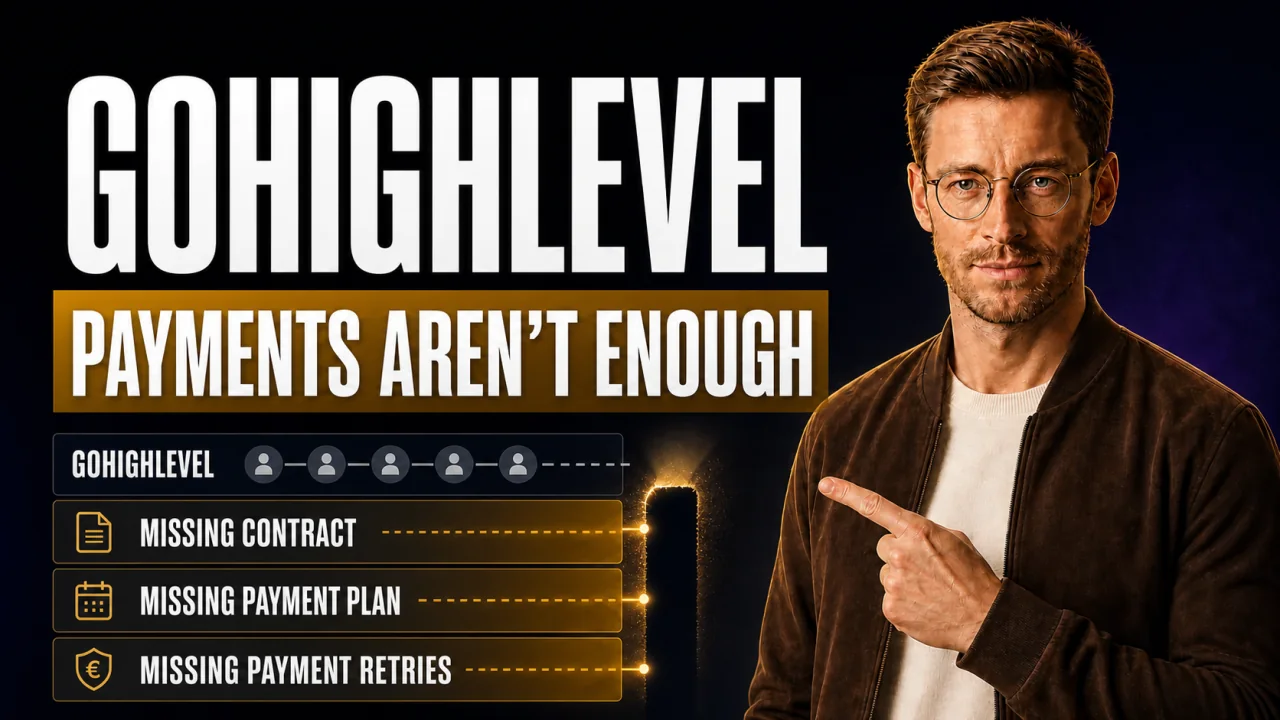
GoHighLevel runs your shop, with CRM and funnels under one roof. Then a $15,000 deal hits the close and the payments layer feels thin. Here is exactly where GHL payments stop and which alternative holds up for high-ticket.
Keep GoHighLevel for the CRM, but do not close high-ticket in the built-in order forms. GHL is a strong agency platform. Its payments layer is a wrapper on Stripe and other gateways, not a closing system.
- GoHighLevel is strong at agency ops, CRM and funnels.
- Payments run through connected gateways like Stripe, with no contract flow.
- No collections process and no closer-driven live price control.
- Real options: ThriveCart, SamCart or GHL plus a dedicated closing layer.
If you only build low-ticket funnels and never cross $500 an order, stop reading here.
Quick map before we go deep. Realistically there are three routes.
One, another all-in-one platform. Two, a checkout tool like ThriveCart or SamCart. Three, keep GHL and put the closing layer next to it.
We walk each route below. Which one fits comes down to a single question. All-in-one, or your own checkout layer?
GoHighLevel and a dedicated high-ticket checkout compared
| Criterion | GoHighLevel | Dedicated checkout (e.g. CloserCart) |
|---|---|---|
| When it fits | Agency ops, CRM, funnels, many sub-accounts | Closes from $5,000 up on a sales call |
| Strengths | One platform, SaaS mode, rebilling | Signed contracts, live price control, dunning |
| Limits | Standard order forms, no native tax engine | No CRM, no funnels, no email marketing |
| Cost model | From $97 a month plus usage fees | 49 to 99 euros a month, 0% revenue share |
What GoHighLevel is genuinely good at
Honestly, GoHighLevel earned its run. CRM, pipelines, funnels, email, SMS and calendars sit under one roof.
The agency model is the strong part. The Unlimited plan gives you unlimited sub-accounts. Agency Pro stacks SaaS mode on top.
Then there is rebilling. You can pass communication usage through to your clients. On Agency Pro you can even add a markup.
Run ten client accounts with funnels and follow-ups and the math works. Five separate tools cost more in total. The core point: GHL is an agency operating platform, not a checkout product.
It only breaks when you treat the payments layer as a full closing system. Almost everyone selling high-ticket on the phone does exactly that.
What GoHighLevel gets right
- One login for CRM, funnels, automations and calendars.
- Sub-account structure scales cleanly across many clients.
- Rebilling lets you pass usage costs on to clients.
Where it gets thin
- The plan price is only half the bill, usage fees stack on top.
- Checkouts are standard order forms on Stripe and other gateways.
- No native tax engine and no documented sequential invoicing.
What GoHighLevel actually costs
The plans look simple on the page. The catch sits one level down. Usage.
- Starter: $97 a month, three sub-accounts.
- Unlimited: $297 a month, unlimited sub-accounts.
- Agency Pro: $497 a month, plus SaaS mode and rebilling.
- Enterprise: priced on request, with a white-label app.
Those numbers are the floor, not the bill. Every plan sits on a wallet that gets charged for usage. The official pricing guide lists the rates.
Email runs $0.675 per 1,000 sends. Validation costs $2.50 per 1,000. Premium workflow actions bill $0.01 per execution.
Phone and SMS run at Twilio rates. WhatsApp costs $10 per month per sub-account. Channel conversation fees land on top of that.
None of this is unfair. You just have to budget for it. Otherwise the wallet charge at month end surprises you.
So never price the plan in isolation. Several sub-accounts with active email and SMS push the usage share up fast. That bites the day you calculate margin per client to the dollar.
Honestly, at your size this is not the expensive part. Close six figures a month and $300 in tool costs barely registers. The expensive stretch is where contract value gets left on the table.
The payments layer: a wrapper on gateways
Now to the heart of it. How does a buyer actually pay inside GoHighLevel?
GoHighLevel payments: GoHighLevel ships no payment processor of its own and connects third-party gateways instead. Payments run through Stripe, PayPal, NMI, Authorize.net, Square, Adyen or Razorpay. GHL supplies the order forms, invoices and documents, while the actual processing and the processor fees sit with the gateway.
That is a legitimate model. The processor fee comes from the gateway, not from GHL. On Stripe in the US that is 2.9% plus $0.30 for standard domestic cards.
International cards cost more, with roughly another 1.5% on top. On a $25,000 close that difference is real money. Worth knowing before you quote a client abroad.
Inside documents your buyer can even pick between connected gateways. Stripe or PayPal, depending on what you set up. Handy.
But it stays a standard checkout. Open the order form, pay the amount, done.
The official payments docs describe no closer-driven live price flow. So your closer cannot move price or payment plan during the call. That is where most teams trip.
On a $19 funnel none of that matters. On a $25,000 engagement you are missing the one tool for the moment of decision.
The difference sounds academic and is huge in practice. A standard checkout assumes the price is fixed before the call. High-ticket works the other way around.
A setup on your own accounts is covered in our overview of the best payment providers for coaches.
Contracts and signature: well built, thin where disputes happen
GHL has a built-in Documents and Contracts feature. E-signature with a certificate, IP, email and timestamp is part of it. Templates and embedded payments inside the document too.
That is properly built. A buyer can sign inside the document and pay right there. One-time or recurring.
Quick detour before we move on. The official docs talk about legally binding signatures.
In the US that claim holds up fine. E-signatures are standard practice for this kind of agreement. Legality is not the gap here.
The gap shows up in a dispute. A card network never asks whether a signature felt valid. It asks for the evidence package.
That means the signed scope, the payment schedule and the terms your buyer accepted. Ideally in one file with one reference number. Assembling that from three systems under a deadline is where it hurts.
What a closing setup has to deliver is laid out in the checkout platform comparison.
The expensive assumption
"The buyer signed digitally, so we are covered." That assumption cracks when a $20,000 client disputes in week four. The card network wants signed scope, accepted terms and payment record in one file.
Failed installments: retries are not collections
Now the annoying part. What happens in GHL when an installment bounces?
The official support docs are transparent here. Subscriptions have configurable retries, up to 3 attempts. You can set the gaps to 1, 3, 5 or 7 days.
After that the subscription flips to unpaid or cancelled. Recurring invoices with auto-payment add 2 more retries. Those run 24 hours apart.
There are automated payment reminders for invoices too, across several touchpoints. Anything beyond that you build yourself in workflows. The filter is called Payment Status equals Failed.
Myth
"GoHighLevel has invoice reminders and retries, so my collections are covered."
Reality
Retries and reminders are a technical repeat system, not a past-due process. The official docs show no escalation stages, no late-fee logic and no collections handoff. With six figures of installments outstanding, that stretch decides between cash and a write-off.
In daily practice the gap gets concrete fast. A retry asks the card three more times. It never sends anyone a notice with a deadline.
What a real past-due process looks like sits in the piece on automating your dunning process. First reminder through to handoff. The distance to a retry system gets obvious quickly.
Day to day: invoices, sales tax and currency
Okay, quick detour into the daily grind. GHL charges your wallet automatically when it runs low. What you get back is a receipt.
The public ideas board is the interesting read. Users have open requests there for proper invoices on the wallet auto-recharge. Better multi-currency support sits in the same list.
Both are user requests, not shipped features. Worth checking before you plan around either one.
Tax looks similar. There is no native engine that handles sales tax nexus or VAT for you.
In practice the calculation runs through Stripe Tax or an external automation. The how-to guides for that come from the community. It works, it is just assembled rather than built.
Currency matters the moment you sell across a border. A Canadian or UK client on a $20,000 program raises the question immediately. I have watched that turn into a spreadsheet nobody wanted to own.
The trap I have seen a setup where sales tax logic ran through a self-built workflow. It sat misconfigured for three months, on deals between $15,000 and $30,000. The accountant found it at quarter close and the cleanup took days.
The fix Tax and contract logic belong in a system built for them. My rule since then: funnels and CRM may be duct-taped, the closing and payment path never.
Who the GHL payments are actually built for
The plan structure gives away the target user. The Unlimited plan advertises rebill phone and email with no markup. Agency Pro calls it rebill with markup.
The payment feature set points straight at the agency reselling model. The platform optimizes for an agency passing communication usage through. Clean business model, just a different problem than yours.
You do not want to rebill usage. You want a signed agreement for $22,000. And the first payment the same day.
Those two worlds happen to share the word payments. Not much else.
Once you spot it you see it everywhere in the docs. Wallets, rebilling and sub-account charges are agency logic. Contracts, payment plans and escalation stages are closing logic.
Mix up the two layers and you buy the right tool for the wrong problem. It shows up the quarter your first six figures run through payment plans. Suddenly nobody is tracking the open items cleanly.
When GoHighLevel stays the right call
Fair is fair, the other side belongs here too. There are setups where switching would be pure waste.
Offers under $5,000 that sell without a call do fine on an order form. The buyer clicks, pays and lands in the funnel. GHL plays to its strength there.
Same for an agency with many client accounts. Sub-accounts, rebilling and SaaS mode model exactly that business. No dedicated checkout competes on that ground.
The documents feature is better than its reputation too. E-signature, templates and embedded payments in one document is a serious function. For plenty of US sellers that is enough.
People mess this up by turning one missing detail into a full platform migration. Check first what share of your revenue actually gets negotiated on a call. If that share is small, leave everything alone.
The alternatives, mapped
So. Now to the actual alternatives. There are three honest routes.
Route 1: another all-in-one platform. If your problem is the interface or the support rather than payments, switching helps. The payments question travels with you though.
The same names come up in that category. Keap, HubSpot or ActiveCampaign. All three are serious CRM and automation systems.
Their quality is not the point. The checkout is a module beside many others there too. Same pattern, different logo.
So test every candidate on the same three questions. Otherwise you buy the identical problem in a new interface.
- Can a closer change price and payment plan live on the call?
- Is there a signed agreement with a real evidence trail?
- Is there a genuine past-due process, not just retries?
Route 2: a dedicated checkout tool. Vendors like ThriveCart or SamCart make the purchase itself the main product. For self-serve checkouts that is a solid category.
How they hold up on call-closed deals sits in our piece on ThriveCart alternatives. Short version: strong on order bumps and funnels. Thin on contracts and collections.
Route 3: the combination. GHL stays your CRM and funnel system. Closes above $5,000 run through a dedicated checkout layer.
Contract, signature and dunning then sit where they belong. Not either-or, just division of labor.
One note in my own interest, so nothing here reads too rosy. CloserCart has no native GHL integration. Close is the CRM that connects directly, so with GHL you write the closed status back yourself.
Here is how the three routes line up. After that the decision usually gets easy.
The three routes side by side
| Route | Examples | Strong at | Open flank |
|---|---|---|---|
| Other all-in-one | Keap, HubSpot, ActiveCampaign | CRM, funnels, automations | Payments question stays open |
| Checkout tool | ThriveCart, SamCart | Order bumps, self-serve funnels | Thin on contracts |
| GHL plus closing layer | GoHighLevel and CloserCart | Live price, contract, dunning | Second tool in the stack |
Want out of the all-in-one idea entirely? The comparison of ClickBank alternatives draws the line to the reseller model. That is a separate construction site.
From the field
I decide this with one question: does the price get negotiated on the call? If yes, the close belongs where a closer moves amount and plan live. At CloserCart that plan is called a Split. If no, a standard checkout is plenty and GHL does its job.
What the second layer costs
That leaves the question everyone asks first. What does it cost to run a second layer alongside?
CloserCart Starter runs 49 euros a month with one product. Pro is 99 euros with unlimited products and a custom domain. Both plans include one closer.
Every additional closer costs 49 euros a month. Billed annually that works out to 490 and 990 euros. There is no revenue share.
Still, this is not a pure price duel. The two systems solve different jobs. You are adding a layer here, not replacing one.
So compare it against the leakage, not against the plan price. One saved $18,000 deal carries this layer for years. If your math says otherwise, skip it.
The deal that died on a payment link
Short story from one real month. We booked over $400,000 in contract volume. One of my closers had an $18,000 deal on the phone.
The buyer wanted in, but not on the standard terms. Deposit now, the rest over six installments starting next month.
Our setup back then: checkout links built in advance, one per price variant. For that exact combination none existed.
The closer messaged me while I was driving. Almost two hours passed before I was at a keyboard.
The buyer was still there, but the energy had gone. Where can I sign turned into send me everything by email. Two weeks of follow-up, then a no.
Not because of the price. Because of the moment we missed.
The bitter part: everything was technically in place. Payment providers connected, funnel clean, CRM tidy. We just could not build a term and close it on the call.
Since then I judge every closing system on that one moment. Not on the feature list.
Unpopular opinion: switching tools is usually the wrong project
The usual advice: if GHL annoys you, migrate to another platform. In most cases I think that is wrong.
A migration costs you weeks. Moving funnels, rebuilding automations, retraining the team. Not fun, but that is the job.
At the end you have another all-in-one platform with standard checkouts. The payments layer is a wrapper everywhere and never the core.
The better metric is not which tool is better overall. It is this: how much contract value do you lose per quarter at the moment of the close?
Count the deals that died on missing terms. Add the agreements nobody can find. And the installments with no chase behind them.
If that number runs five figures, you do not swap the platform. You add the one layer that is missing.
Anyway. You can still cancel GHL later. Fixing the closing layer first gets you the fastest result.
What I would do in the first 7 days
Say you keep GHL for the CRM. You want the closing layer cleanly beside it. Here is how I would run week one.
- Price your GHL setup honestly: plan cost plus wallet usage from the last three months.
- List every deal in the last 90 days that died on terms, contract or payment timing.
- Decide which offers above $5,000 move onto the dedicated checkout layer.
- Connect your own payment accounts, Stripe and PayPal for example, to that checkout.
- Build your contract once with digital signature, terms acceptance and a refund policy clause.
- Test the live flow with a closer: change the amount, set a Split, close on the call.
- Decide who writes the closed status back into the GHL CRM.
Checklist before you decide
- Plan cost plus wallet usage from the last three months added up
- Deals lost or stalled in the last 90 days written down
- Signature flow checked against what a dispute actually requires
- Past-due path defined for open installments, not just retries
- Decided which offers run through which checkout
- Live price flow rehearsed once with the team
Sources
- GoHighLevel Pricing (official)
- HighLevel Pricing Guide: Wallets, Charges, Rebilling (official docs)
- Documents & Contracts in HighLevel (official docs)
- Subscription Failed Payment Retries (official docs)
- Automated Invoice Reminders (official docs)
- HighLevel Ideas Board: open invoicing and currency requests
- Stripe Pricing, United States (official)
Frequently asked questions about GoHighLevel alternatives
Can I run GoHighLevel and a dedicated checkout side by side?
Yes, and for high-ticket that is the smartest setup. GHL stays your CRM and follow-up system, so you add a layer instead of migrating. Closes above $5,000 then run through the dedicated checkout layer, with contract and signature attached.
Does GoHighLevel charge its own payment fees?
GHL ships no payment processor and connects gateways instead. The processing fee therefore comes from the gateway, with Stripe at 2.9% plus $0.30 on standard US cards. GHL itself bills the plan price plus usage fees for email, SMS, WhatsApp and premium workflow actions.
Is the GoHighLevel e-signature enough for coaching contracts?
The official docs describe e-signatures with a certificate, timestamp, IP and email address. In the US that is workable for this kind of agreement. What is missing is one evidence package for disputes: signed scope, accepted terms and payment record in a single file.
Can GoHighLevel chase failed installments?
GHL offers retries with up to 3 attempts and automated payment reminders for invoices. A past-due process with escalation stages, late fees or a collections handoff is not documented. For that you build workflows on the failed payment filter or run a separate system.
What does GoHighLevel cost per month?
The official monthly plans are Starter $97, Unlimited $297 and Agency Pro $497, with Enterprise priced on request. Usage lands on top of that. Rates include $0.675 per 1,000 emails, $2.50 per 1,000 validations and $0.01 per premium workflow action.
Your payment accounts, your close, your contract
CloserCart runs cards, Klarna and PayPal on your own Stripe account, behind one checkout your closer steers live. Contract PDF with digital signature included, from 49 euros a month. See all payment providers at a glance.
Start now for €1 14 days for €1. Cancel monthly. 0% revenue share.